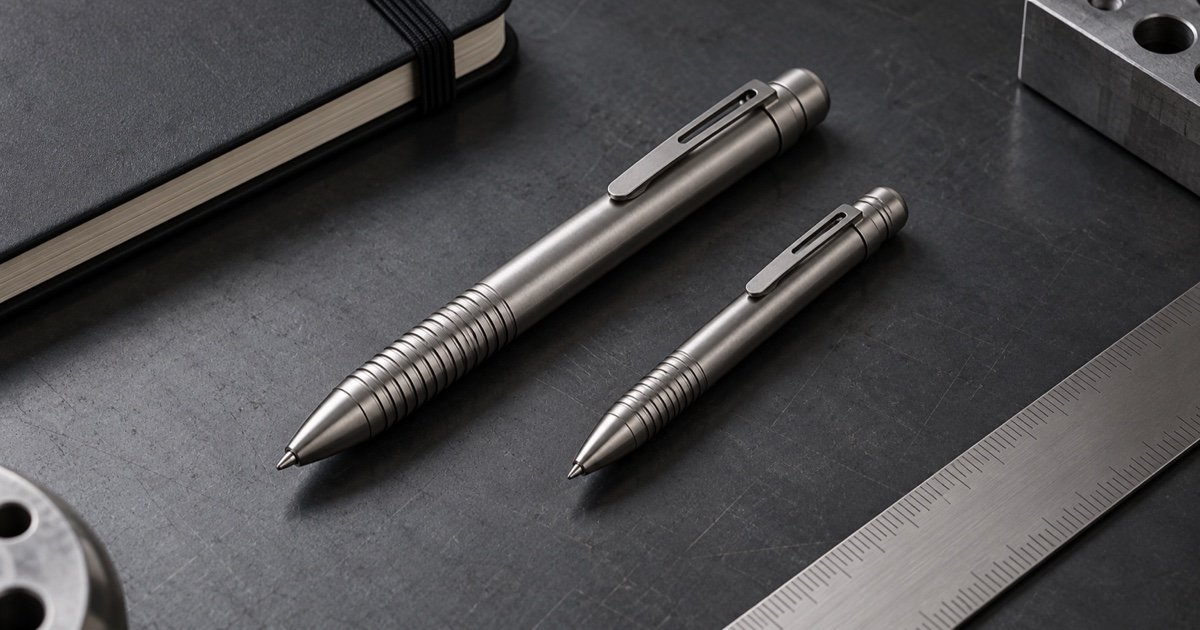
A mini titanium tactical pen is not simply a full-size pen shortened in CAD. Reducing length changes the available refill space, mechanism layout, grip area, clip position, balance, writing posture, and the way the product fits a pocket or keychain. A compact design can improve portability, but it may also require more deliberate component and ergonomic choices.
For buyers and product teams, the right format depends on the intended writing task, carry method, user expectations, and product-line role. This comparison helps separate meaningful size decisions from appearance alone.
What Counts as Mini or Full Size?
There is no universal length that separates mini and full-size tactical pens. The useful distinction is functional. A full-size pen generally offers a familiar writing grip and space for a broader range of standard-length components. A mini pen prioritizes a smaller carry envelope and may use a compact refill, shortened internal support, cap, telescoping arrangement, or keychain-oriented body.
Define the complete configuration instead of relying on the label. Record overall length, usable grip length, diameter, installed refill, mechanism, clip, cap or rear component, and carry attachment. Two pens with similar external length can feel different because their grip and balance are arranged differently.
Mini vs Full-Size Titanium Tactical Pen Comparison
| Decision factor | Mini titanium pen | Full-size titanium pen |
|---|---|---|
| Carry envelope | Shorter body can suit compact pockets, organizers, or keychain carry | Longer body usually occupies more pocket depth but can be easier to retrieve |
| Grip area | May support fewer finger positions or require a narrower writing posture | Usually provides more room for different hand sizes and grip styles |
| Refill options | May require compact refills, trimmed support, or a dedicated spacer system | Can offer more room for common full-length refill formats, subject to exact compatibility |
| Mechanism packaging | Internal travel and component stacking are more constrained | Provides more room to separate mechanism, refill support, and service access |
| Balance | Small changes in clip, cap, or rear hardware can strongly affect feel | Longer geometry gives more freedom to distribute mass but still needs validation |
| Writing sessions | Optimized for quick notes when grip and refill are appropriate | Often better suited to longer writing when diameter and balance are comfortable |
| Carry attachment | Key ring, compact clip, cap, or organizer slot may define the product | Pocket clip and conventional pen carry are more common choices |
| Brand positioning | Can serve as a backup, travel, keychain, or compact EDC option | Can function as the primary writing platform or flagship pen body |
Start With the Carry Method
Decide whether the pen belongs in a front pocket, shirt pocket, notebook loop, pouch, bag, organizer, or keychain system. A short pen may be easier to pack but harder to retrieve from a deep pocket. A key ring improves attachment while adding movement, noise, and another contact point. A full-size clip can provide familiar access but needs enough body length and mounting space.
The comparison of pocket carry and keychain carry for compact EDC tools helps teams decide which architecture fits the user. If pocket discretion matters, also review deep-carry versus standard pocket clips rather than assuming a shorter body automatically carries better.
Protect Enough Usable Grip Length
Overall length can be misleading. A cap, clip mount, transition, mechanism release, or attachment hole may occupy space that the fingers cannot use. Measure the actual grip zone and observe where users place the thumb and index finger. A compact pen should still let the intended user control the tip without forcing fingers onto uncomfortable edges or moving components.
Diameter also changes the result. A short but thick pen may feel stable for quick notes, while a very slim compact pen may require more finger force for some users. Evaluate several hand sizes and writing angles. The broader guide to what makes a good titanium tactical pen connects grip, mechanism, clip, refill, and finish decisions.
Choose the Refill Before Freezing the Body
A refill determines more than ink. Its overall length, tip geometry, shoulder position, rear support, spring interface, and writing point affect the body and mechanism. Mini designs have less room to absorb compatibility differences. Cutting a spacer or spring during development may create a working sample, but production needs a controlled bill of materials and assembly method.
Use the titanium tactical pen refill guide to document exact approved refills. Do not claim compatibility with an entire refill family until each named option has been checked in the final pen.
Fit the Mechanism to the Available Space
Bolt-action, click, side-slider, and capped arrangements use length differently. A compact body can reduce available travel, spring space, thread engagement, or component separation. A full-size body provides more room, but a poorly placed mechanism can still create rattle, incomplete extension, or an unbalanced rear section.
Compare the mechanism implications in bolt-action, click, and capped titanium pens. Test the production-intent mechanism slowly for scraping and incomplete engagement before beginning any cycle plan.
Evaluate Balance in the Complete Configuration
Titanium can support a lightweight product, but the material name does not determine balance. The clip, refill, spring, bolt, button, cap, key ring, glass-breaker component, and hollowing strategy all move the center of mass. In a mini pen, one small rear component can represent a larger share of the total assembly.
Follow the process in the titanium tactical pen weight and balance guide. Measure and test the assembled pen with the approved refill and all carry hardware installed.
Review Clip Position and Pocket Behavior
A mini pen may not provide enough separation between the clip mount, grip, and tip unless these features are planned together. The clip should not block the preferred grip or make the short pen rotate excessively in a pocket. A full-size pen can offer more mounting choices, but leverage and exposed length still affect carry.
Use the EDC pocket clip design guide to review ramp, clearance, preload, contact, fasteners, and return. Test representative fabrics and seam thicknesses rather than judging retention by hand alone.
Connect Size With Body Construction
A hollowed body can reduce mass while preserving external volume, but internal walls, thread interfaces, transitions, and machining access need control. A solid or less hollowed compact pen may feel dense for its size. Neither approach is automatically better.
The comparison of hollow and solid titanium pen bodies explains the manufacturing and user-experience tradeoffs. Review wall thickness and critical intersections using the final mechanism and refill layout.
Test Mini and Full-Size Pens With the Same Framework
- Record the exact body, refill, spring, spacer, mechanism, clip, cap, and attachment configuration.
- Measure overall length, usable grip length, diameter, tip extension, and critical interfaces.
- Evaluate writing control during quick notes and a longer task.
- Check retrieval, insertion, rotation, snagging, and adjacent-pocket contact.
- Replace the refill using the intended tools and instructions.
- Operate the mechanism and inspect fasteners after the agreed test sequence.
- Clean the pen, inspect finish wear, and record user feedback separately from dimensional results.
Use the detailed titanium tactical pen sample testing checklist before production approval.
Common Size-Selection Mistakes
- Shortening the body before selecting the refill and mechanism.
- Comparing overall length but ignoring usable grip length.
- Calling a pen keychain-ready without testing the attachment and carry motion.
- Using the same clip position on mini and full-size bodies.
- Assuming a small pen will automatically feel light or balanced.
- Claiming broad refill compatibility from one working sample.
- Approving the compact appearance without testing actual writing tasks.
Which Size Should You Choose?
Choose a mini pen when compact carry, keychain integration, travel, or quick-note use is central—and the final refill, grip, and mechanism remain practical. Choose a full-size pen when familiar writing posture, broader component space, and extended use are higher priorities. A coordinated product family can offer both, but each size needs its own validated specification.
Compare the mini titanium EDC pen platform, the full-size titanium bolt-action pen platform, and the broader titanium tactical pen category as starting references.
FAQ
Do mini titanium tactical pens use standard refills?
Some can, while others require compact refills or dedicated support components. Compatibility must be confirmed for the exact refill and pen configuration.
Is a mini titanium pen comfortable for long writing?
It depends on usable grip length, diameter, balance, texture, hand size, and writing style. Test the intended use rather than inferring comfort from overall length.
Is a full-size tactical pen always heavier?
No. Hollowing, wall thickness, mechanism, clip, refill, and other components affect total mass. Compare completed assemblies.
Can one mechanism be reused across both sizes?
Possibly, but travel, component stack, refill support, balance, and assembly interfaces require separate validation.
Planning a Titanium Tactical Pen Line?
Explore the EDC Gear hub for related product decisions. Brands can review Alloywright’s product development capabilities or share a reference pen, sketch, or requirement sheet for project review.