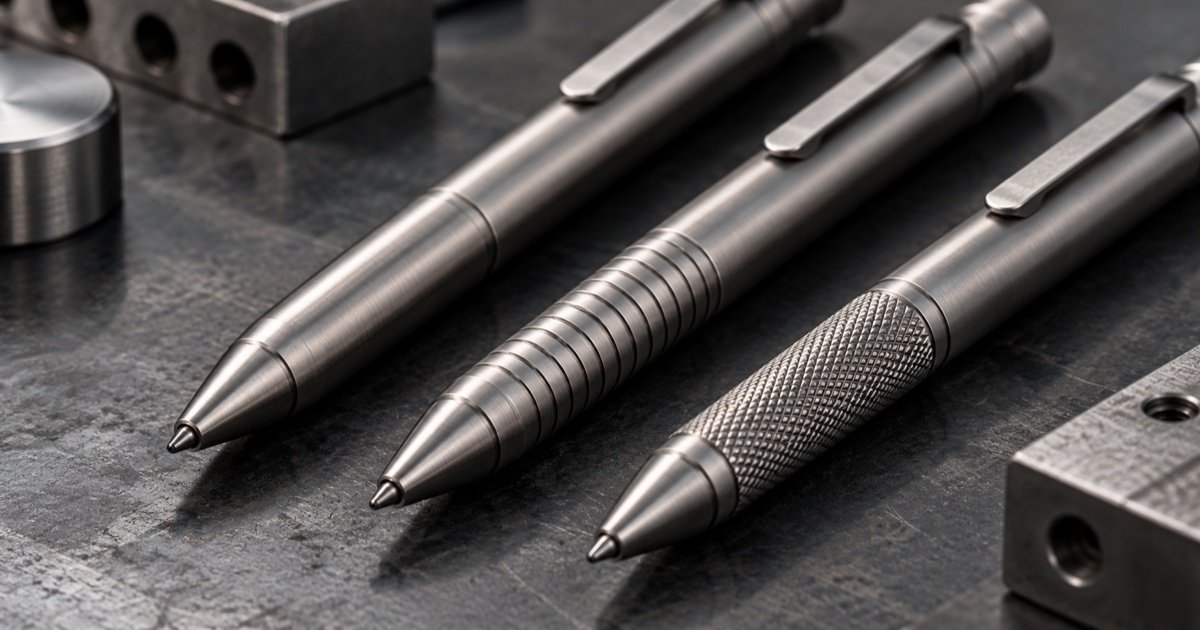
Grip texture changes how a titanium tactical pen feels, looks, carries, cleans, and repeats in production. A smooth grip can slide easily into a pocket and show the finish clearly. Grooves add directional features without covering the whole surface. Knurling creates a dense tactile pattern, but its depth and sharpness require careful control.
The most aggressive texture is not automatically the most secure or comfortable. Brands should select a pattern according to writing posture, wet or gloved use, pocket contact, finish, cleaning, and the visual language of the product.
Separate Grip Geometry From Surface Finish
Grip geometry is created by the shape of the body: smooth cylinders, tapers, grooves, flats, knurling, or other machined features. Surface finish changes the texture and appearance applied to that geometry, such as blasting, stonewashing, brushing, polishing, or anodizing.
The two interact. A blasted smooth grip may feel different from a polished smooth grip. Knurling can catch finishing media or display high points differently from recessed areas. Document both the geometry and finish rather than using “textured grip” as a complete specification.
Titanium Tactical Pen Grip Comparison
| Decision factor | Smooth grip | Grooved grip | Knurled grip |
|---|---|---|---|
| Tactile definition | Low geometric texture; feel depends strongly on finish and diameter | Distinct ridges and recesses can guide finger position | Dense pattern provides strong tactile feedback when properly controlled |
| Writing comfort | Few pressure points, but may feel slippery in some conditions | Comfort depends on groove pitch, depth, edge condition, and grip location | Can create pressure points if the pattern is too sharp or deep |
| Cleaning | Usually the simplest surface to wipe | Debris can collect in recesses | Dense valleys may retain lint, dust, or residue |
| Pocket interaction | Generally slides against fabric with less mechanical engagement | Raised edges can increase fabric contact | Aggressive peaks may abrade fabric or catch adjacent items |
| Appearance | Shows body proportion and finish clearly | Creates a controlled technical rhythm | Produces a prominent industrial or tool-like visual |
| Machining control | Geometry is simpler, but straightness and finish remain visible | Requires consistent pitch, depth, endpoints, and transitions | Requires pattern definition, tool condition, alignment, and consistent termination |
| Inspection | Focus on diameter, taper, finish, and cosmetic condition | Measure or compare groove geometry and edge condition | Evaluate pattern coverage, sharpness, damage, finish, and approved tactile range |
Choose Texture for the Writing Task
A tactical pen still needs to work as a pen. Observe where users naturally place their fingers and which zones carry pressure during short notes and longer writing. Texture placed too far forward may interfere with the tip transition. Texture placed too far back may add cost and appearance without helping control.
The guide to what makes a good titanium tactical pen explains how grip, diameter, balance, mechanism, refill, and clip work as a system. Test the complete pen rather than a textured tube by itself.
Smooth Grips: Simple Geometry, Visible Finish
A smooth grip can support frequent pocket insertion, easy wiping, and a clean visual silhouette. It also makes diameter, taper, and surface finish more important because there are fewer geometric features to change tactile feedback. A polished surface may behave differently from a blasted or brushed one.
Smooth does not mean featureless. A controlled taper, subtle flats, or a localized transition can help orientation without adding a full pattern. Review finish options through the titanium surface finish guide and prototype the exact combination.
Grooved Grips: Control Pitch, Depth, and Endpoints
Circumferential or longitudinal grooves can provide directional reference and a recognizable design detail. Their effect depends on spacing, depth, corner condition, and the width of the remaining lands. Widely spaced shallow grooves feel different from narrow deep ones.
Show where the groove pattern starts and stops. Avoid an uncontrolled partial groove near a clip, thread, logo, or body transition. The endpoints should look intentional and should not create a sharp edge where the fingers rest.
Knurled Grips: Define the Pattern, Not Just the Name
“Knurled” can describe different patterns, pitches, depths, peak shapes, and production methods. State the intended pattern and tactile result, then retain approved samples or range references. A dense diamond pattern may provide strong orientation, but excessive sharpness can reduce writing comfort and increase pocket wear.
Inspect for crushed peaks, double tracking, incomplete coverage, irregular termination, and finish differences across high and low areas. If the design uses replaceable grip components, alignment and reassembly also need control.
Consider Wet Hands and Gloves Without Over-Claiming
Texture may improve tactile feedback in some wet or gloved conditions, but the result depends on water, oils, gloves, hand size, grip force, diameter, and finish. A pattern should not be advertised as slip-proof without an approved method and evidence.
Use the approach in designing compact metal EDC tools for glove use to check access, orientation, actuation, and writing control with representative gloves and tasks.
Check Pocket Wear and Adjacent-Item Contact
A grip that feels secure in the hand may be abrasive in a pocket. Knurled peaks and sharp groove shoulders can rub fabric, scratch adjacent objects, or catch an organizer loop. Smooth grips can carry more quietly but may need the clip or body geometry to provide orientation.
Test the grip with representative pocket materials, bags, and organizers. Combine this with the EDC pocket clip design guide because clip pressure and grip texture can act together on fabric.
Plan Cleaning and Maintenance
Ink, lint, dust, skin oils, and finishing residue can collect in textured areas. Confirm how the approved finish should be cleaned and whether a brush, cloth, water, or another method is appropriate for the complete pen. Do not recommend a chemical without checking the finish and other components.
The article on cleaning titanium EDC gear without harming the finish provides a conservative maintenance framework. Product instructions should reflect the final assembly, not only the titanium body.
Coordinate Texture With Balance and Diameter
Texture does not compensate for an uncomfortable diameter or poor balance. Deep knurling can change the effective grip diameter. Long textured zones can change the visual and tactile center of the pen. A heavy rear mechanism may still make the pen feel unstable even when the grip has high traction.
Use the titanium pen weight and balance guide to record complete configuration and user feedback. Compare measurable geometry with subjective comfort instead of treating them as the same result.
Specify and Inspect Grip Texture
- Define the grip zone and intended finger positions.
- Specify the base diameter, taper, flats, or other controlling geometry.
- Define groove or knurl pattern, pitch, depth, coverage, and endpoints as needed.
- State edge-break and finish requirements for peaks, valleys, and transitions.
- Identify cosmetic zones and permitted variation.
- Use controlled lighting plus dimensional and tactile comparison methods.
- Retain an approved sample or range when tactile judgment matters.
- Recheck after any tool, finish, geometry, or supplier-process change.
The article on specifying edge breaks and chamfers on titanium EDC products helps define transitions around the grip pattern.
Common Grip-Texture Mistakes
- Choosing the most aggressive pattern without testing writing comfort.
- Specifying “knurled grip” without pattern or tactile criteria.
- Ignoring groove or knurl termination near the fingers.
- Approving texture before selecting the final surface finish.
- Testing grip in the hand but not in a pocket or organizer.
- Using one pattern across different pen diameters without reevaluation.
- Judging production only from photographs that cannot show tactile sharpness.
Which Grip Should You Choose?
Choose a smooth grip when clean handling, easy maintenance, and a restrained visual are priorities. Choose grooves when the design needs controlled directional cues or a technical rhythm without full-surface texture. Choose knurling when strong tactile definition supports the use case and testing confirms acceptable comfort, cleaning, and pocket behavior.
Compare the textured bolt-action titanium pen, the faceted titanium tactical pen, and the full titanium tactical pen category as reference platforms.
FAQ
Is knurling always more secure than grooves?
No. Pattern geometry, diameter, finish, hand condition, glove type, and grip force affect the result. Test the complete pen.
Can anodizing be applied over knurling?
Potentially, but preparation, color appearance, contact points, recesses, and batch variation require project-specific review and approved samples.
Do grooves make a tactical pen easier to clean?
Not necessarily. Grooves may be more open than dense knurling, but depth, spacing, finish, and contamination determine cleaning behavior.
How should grip sharpness be inspected?
Combine geometry and visual inspection with a defined tactile comparison or approved range sample. Avoid relying on an undocumented fingertip judgment.
Developing a Titanium Tactical Pen Grip?
Explore the EDC Gear hub for related pen decisions. Brands can review Alloywright’s development capabilities or submit a reference pen, drawing, or grip requirement for project review.