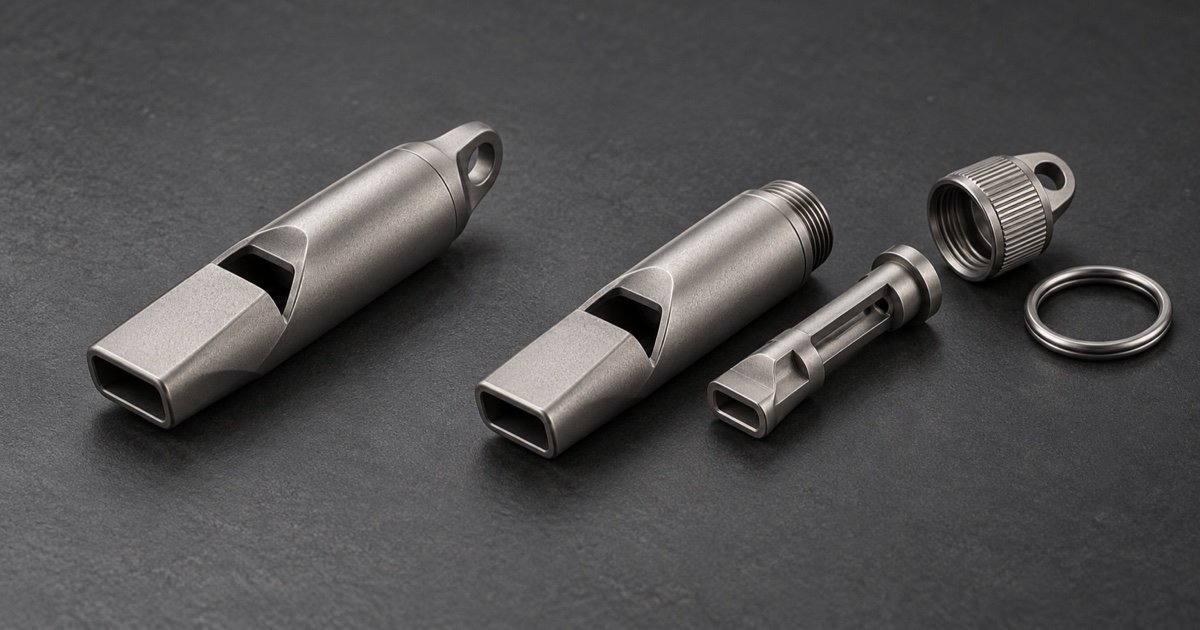
An emergency whistle can use an integrated body with relatively few assembled interfaces, or a modular construction with separate end pieces, inserts, attachment features, or related components. Both approaches can support a useful outdoor product, but they create different questions for assembly, cleaning, durability, customization, inspection, and repeat orders.
For an outdoor brand, construction should follow the intended function and validation plan. A higher part count is not automatically more advanced, and a simpler body is not automatically easier to manufacture. Internal passages, attachment geometry, material choices, and acoustic testing still determine the final result.
What “Integrated” and “Modular” Mean Here
An integrated design combines more of the body, mouthpiece, air path, and attachment geometry into a single primary structure or a small number of permanently assembled elements. A modular design separates functions across multiple serviceable or assembly-stage parts.
These labels describe product architecture, not performance. Two whistles with similar external dimensions can have very different internal geometry. Likewise, a visibly simple whistle may require complex machining, while a modular product may use simpler individual components but demand tighter assembly control.
Integrated vs Modular Whistle Comparison
| Decision factor | Integrated construction | Modular construction |
|---|---|---|
| Part count | Fewer separately controlled components | More components, interfaces, and revision identities |
| Assembly | May reduce assembly steps but can require complex body machining | Adds assembly sequence, orientation, retention, and verification |
| Cleaning access | Fewer joints, but internal passages may be difficult to access | Some parts may be accessible if disassembly is intended and documented |
| Attachment feature | Loop or hole may be part of the main body | Attachment component can be separate or interchangeable |
| Customization | Branding and finish focus on a unified surface | Components may support contrast, variants, or different materials after validation |
| Serviceability | Typically limited if the body is not intended to open | Possible only when parts, tools, instructions, and reassembly controls are defined |
| Inspection | Focuses on body geometry, passages, finish, and output test | Adds interface fit, retention, orientation, and assembled-condition checks |
| Repeat production | Fewer component revisions to coordinate | Requires control of each component plus the assembly specification |
Start With the Intended Use and Carry Method
Define whether the whistle is intended for hiking packs, keychains, emergency kits, life-safety accessories, training equipment, or another context. The carry method influences attachment geometry, orientation, snagging, access, contamination, and whether a removable component is appropriate.
The guide on where to attach an emergency whistle on a hiking pack helps connect product architecture with field access. The whistle should remain reachable and usable in its intended carry configuration; this must be evaluated rather than assumed from a product photograph.
Do Not Infer Acoustic Performance From Part Count
Sound depends on the complete air path and the way the finished product is used. Window geometry, channel arrangement, internal transitions, obstructions, leakage, mouthpiece form, and manufacturing variation can all affect results. An integrated body may reduce some joints, while a modular design may allow certain components to be adjusted or produced separately. Neither guarantees a specific output.
Use a defined test method for the production-intent configuration. The article on how brands should evaluate emergency whistle loudness explains why measurement distance, orientation, environment, samples, and acceptance criteria must be controlled. Any published performance value requires project-specific evidence and internal approval.
Compare Internal Passage and Assembly Control
Integrated construction may place more internal geometry inside one machined or formed body. The team should review tool access, burr removal, cleaning, inspection, and process capability. Modular construction may make individual passages easier to produce, yet every interface adds fit, orientation, retention, and potential blockage questions.
If a threaded joint is used, define engagement, seating, loosening prevention, cleaning, and whether users may open it. If an insert is pressed, bonded, captured, or otherwise retained, specify the process and verification appropriate to the project. Do not treat the assembled product as a black box.
Design Attachment Features as Functional Parts
A lanyard hole, loop, ring, or separate end component must be evaluated with the expected cord, split ring, clip, or pack attachment. Check edge condition, access, rotation, noise, contact with the body, and the way load reaches the main structure.
A modular attachment can support variants, but it also creates another part and interface to control. An integrated loop reduces separate hardware but may influence machining orientation or local geometry. Use the principles in choosing a titanium keychain connector when the whistle is intended to join a broader EDC system.
Plan Cleaning and Moisture Management
Outdoor whistles may encounter moisture, dust, lint, skin oils, or debris. Review where contamination can collect, whether water can drain, what cleaning access is available, and whether any user disassembly is permitted. A joint that can be opened is not automatically serviceable unless the product includes clear instructions and can be restored to its approved condition.
Material and finish selection should match the complete environment and all components. The discussion of titanium EDC gear in coastal and saltwater use highlights why mixed materials, deposits, crevices, and maintenance still require attention even when titanium is selected.
Coordinate Finish, Logo, and Component Appearance
An integrated body provides a continuous visual surface, but fixture points, internal passages, and finish coverage still need review. A modular construction can combine finishes or colors, yet components may vary separately and create alignment or color-matching challenges.
For private-label programs, identify logo location, orientation after assembly, cosmetic zones, permitted contact marks, and whether replacement components must match the original appearance. Use the private-label emergency whistle specification guide to connect construction with branding, packaging, and approval records.
Test the Complete Whistle, Not Only the Components
- Confirm the drawing and revision of every component.
- Inspect internal passages, windows, mouthpiece edges, attachment features, and finish.
- For modular designs, verify fit, orientation, seating, retention, and any user-service instructions.
- Perform the approved acoustic test on the finished configuration.
- Check carry access, attachment compatibility, cleaning, drainage, and handling.
- Repeat relevant checks after environmental exposure or use cycling defined by the project plan.
- Retest after changes to geometry, material, finish, assembly, supplier process, or component revision that can affect function.
For configuration choices, compare single-, dual-, and triple-tube emergency whistles; tube arrangement and body architecture are related decisions but not the same decision.
Common Development Mistakes
- Assuming fewer parts automatically mean lower manufacturing risk.
- Adding removable components without defining who may service them.
- Approving individual parts without testing the assembled whistle.
- Ignoring burrs or contamination inside inaccessible passages.
- Changing an attachment component without reviewing carry and acoustic results.
- Using finish or adhesive choices without checking the intended environment.
- Publishing an output value without a controlled test method and evidence.
- Failing to record component revisions for repeat orders.
Which Architecture Should a Brand Choose?
Choose a more integrated structure when a unified body, fewer assembly interfaces, and straightforward configuration control support the concept—and the required internal geometry can be manufactured and inspected reliably. Choose a modular structure when separate components solve a defined need such as assembly access, product variants, attachment options, or controlled serviceability.
Review the titanium whistle product range for reference platforms. Material alternatives and construction should also be considered together using the comparison of titanium, aluminum, and plastic emergency whistles.
FAQ
Is an integrated whistle always more durable?
No. Durability depends on geometry, material, manufacturing condition, attachment design, use, environment, and the test method. Part count alone is not evidence.
Can users disassemble a modular emergency whistle?
Only if the product is intentionally designed, validated, and documented for user service. Otherwise, opening it may change the approved configuration or damage components.
Does a threaded body affect whistle sound?
Any interface that changes alignment, leakage, obstruction, or internal geometry could matter. The final assembled configuration should be tested using the approved method.
Can different components use different finishes?
Potentially, but compatibility, color variation, masking, contact, assembly marks, and repeat-order control need project-specific review.
Developing a Private-Label Emergency Whistle?
Explore the Outdoor & Preparedness hub for related field-use decisions. Brands can review Alloywright’s product development capabilities or share a reference sample, drawing, or whistle requirement for review.