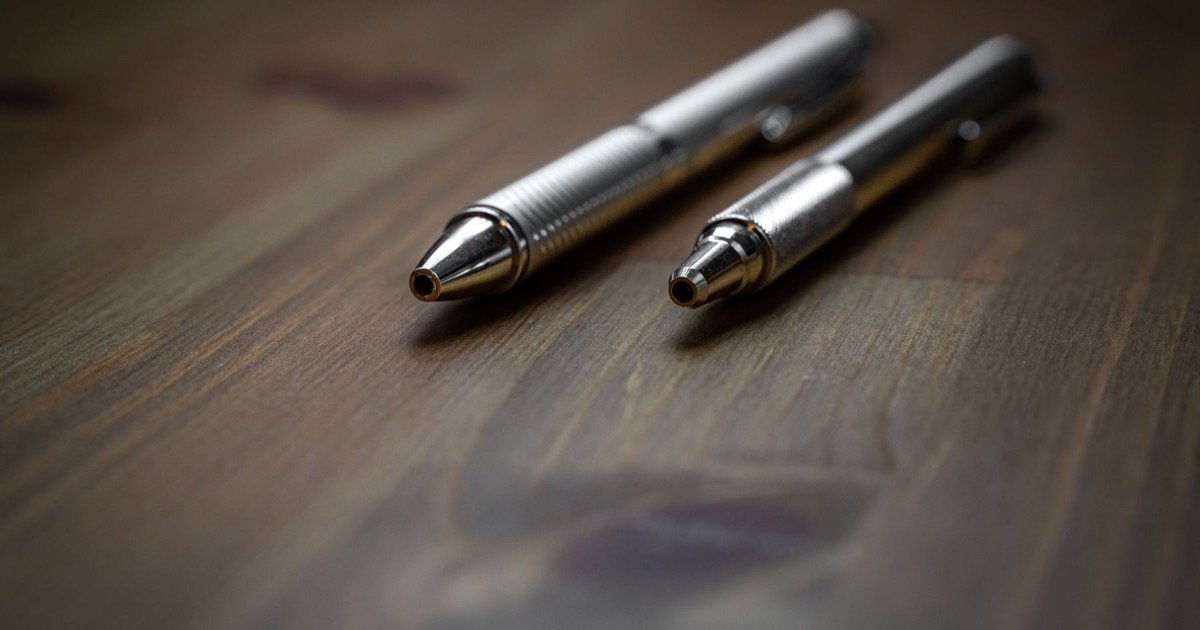
Titanium pen weight and balance affect more than whether a pen feels light or heavy. They influence grip fatigue, tip control, mechanism feel, clip behavior, and how securely the pen sits in a pocket. Two pens with the same total mass can feel very different when one concentrates weight near the nose and the other carries a dense mechanism behind the hand.
For buyers and product teams, the useful question is not “What is the ideal weight?” There is no single value for every user. The better approach is to define the intended writing and carry experience, then evaluate complete production-intent samples with the approved refill, mechanism, clip, finish, and accessories installed.
Weight and Balance Are Different Measurements
Total weight describes the mass of the complete pen. Balance describes how that mass is distributed along its length. A center of balance near the grip may feel neutral in ordinary writing. A nose-heavy design can feel controlled to some users but tiring to others. A tail-heavy pen may require more grip effort to stabilize, especially when a cap is posted.
Measure the complete configuration users will carry. A body-only value excludes components that can meaningfully shift the balance point. If a pen accepts several refills or optional glass breakers, test each approved configuration rather than assuming the difference is negligible.
Titanium Pen Weight and Balance Matrix
| Design factor | How it changes the feel | What to verify |
|---|---|---|
| Body wall and cavity | Removing internal material can reduce mass and shift balance toward other components | Minimum wall, stiffness, bore alignment, and complete-pen balance |
| Nose and grip section | A dense front section can increase tip control or front-heavy feel | Grip comfort, tip visibility, writing angle, and fatigue |
| Mechanism | Bolt, click, twist, or cap components can add mass behind the grip | Actuation, center of balance, rattle, and service access |
| Refill and spacer | Length and construction change the internal stack and weight distribution | Every approved refill with the correct spring and spacer |
| Clip | Clip material, thickness, and position influence pocket orientation and local feel | Retention, insertion force, rotation, and snagging |
| Cap or rear tool | A posted cap or glass breaker can move weight toward the rear | Writing both posted and unposted where applicable |
| Finish and grooves | Material removal and texture can slightly change feel and grip | Production-intent finish, edge comfort, and cleanability |
Start With the Intended Use
A compact backup pen, an all-day writing instrument, and a tactical-style EDC pen do not need the same balance target. Define expected session length, grip position, glove use, pocket location, refill type, and whether the design prioritizes compactness, writing comfort, or a substantial hand feel.
The broader guide to what makes a good titanium tactical pen connects weight with grip, mechanism, clip, and serviceability. If the body is aggressively hollowed, compare the structural and machining tradeoffs in hollow versus solid-machined titanium pen bodies.
Evaluate Grip Diameter and Surface, Not Mass Alone
A light pen can still feel tiring when the grip is too narrow, slippery, sharply stepped, or poorly matched to the user’s writing angle. Conversely, a heavier pen may feel controlled when the grip distributes pressure comfortably. Review diameter transitions, taper, texture, edge breaks, and the distance from the grip to the tip.
Surface finish changes traction and perceived quality. A polished area can feel smoother, while brushed, blasted, or stonewashed surfaces create different visual and tactile responses. Use the titanium surface finish guide to coordinate appearance with handling rather than selecting finish after the ergonomics are fixed.
Account for the Mechanism and Refill
Bolt-action, click, and capped architectures place components in different locations. Rear mechanisms can make a short body feel tail-heavy, while a large nose assembly can pull the balance forward. Review the comparison of bolt-action, click, and capped titanium pens before treating the mechanism as a cosmetic choice.
The refill is also part of the system. Length, tube construction, tip geometry, spring, and spacer can affect both fit and distribution. The titanium pen refill guide explains how to validate approved alternatives without promising universal compatibility.
Check Pocket Carry Separately From Writing
Balance in the hand does not predict carry behavior. Pen length, clip position, clip tension, body diameter, top weight, and protrusion above the pocket all affect stability. A dense rear mechanism can encourage rotation or leaning when the clip is shallow or the pocket fabric is flexible.
Test the pen in representative pants, workwear, bag loops, and organizer slots. Record insertion force, retention, removal, snagging, and whether the clip or body creates pressure during movement. The EDC pocket clip design guide provides a structured way to review these interfaces.
Prototype With More Than One User
Hand size, grip style, writing pressure, and task duration change how balance is perceived. Use a consistent evaluation sheet and multiple representative users. Ask testers to separate first impressions from performance after a longer writing task. Record grip location, configuration, refill, and comments rather than collecting only “good” or “bad” ratings.
Subjective testing should sit beside measurable checks. Record total mass, balance point from a defined datum, overall length, grip diameter, and component configuration. The purpose is not to turn comfort into one universal number, but to make revisions traceable.
Common Development Mistakes
- Quoting a body weight instead of the complete assembled pen.
- Approving balance before the final mechanism, refill, clip, and finish are installed.
- Removing internal material without reviewing minimum walls and local features.
- Using only one evaluator or one short writing session.
- Testing writing comfort but ignoring pocket rotation and clip retention.
- Changing the refill or rear accessory without reassessing the balance point.
A structured sample plan can combine these checks with the titanium EDC prototype testing checklist.
Production Validation Checklist
- Define the approved complete configuration and intended use.
- Record total mass and balance point using a repeatable method.
- Evaluate grip comfort, tip control, writing angle, and extended use.
- Test each approved refill, spring, spacer, and mechanism setting.
- Review pocket carry with the production clip and final surface finish.
- Check representative samples for variation in weight, fit, actuation, and feel.
- Retain the approved data and sample revision for repeat orders.
FAQ
Is a lighter titanium pen always more comfortable?
No. Comfort also depends on balance, grip diameter, surface texture, writing angle, refill behavior, and session length.
Where should a pen’s balance point be?
There is no universal location. It should be evaluated relative to the intended grip and complete configuration, then validated with representative users.
Can changing the refill affect balance?
Yes. Refills, springs, and spacers vary in construction and position. The effect may be small, but it should be checked when multiple configurations are marketed.
Developing a Titanium Tactical Pen?
Browse the titanium tactical pen category and EDC Gear hub for related design decisions. Brands can review Alloywright’s development capabilities or share a pen concept or reference sample for a project discussion.