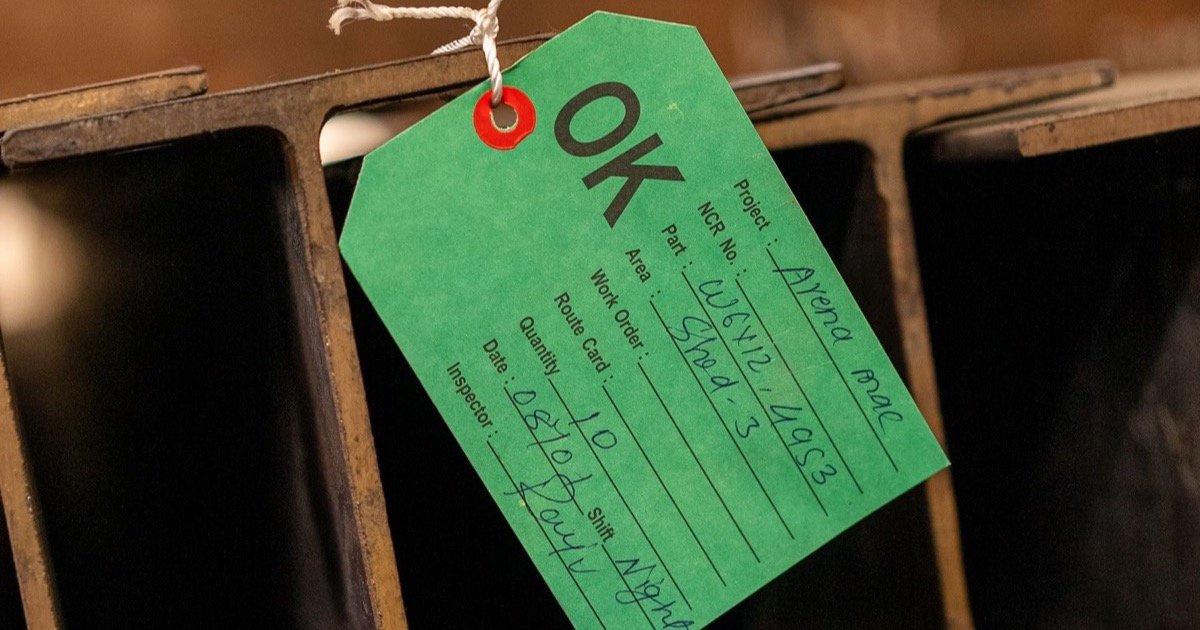
A titanium material certificate can support grade verification and traceability, but it should not be accepted just because the document says “titanium.” Buyers need to connect the certificate to the purchase requirement, the correct product form, the delivered stock, and the finished EDC parts. A complete review asks what specification applies, which results are reported, and whether the identification chain remains intact through production.
Names vary across suppliers and markets, including material test report, material test certificate, mill certificate, or inspection certificate. The name alone does not establish the document’s content or level of independent verification. Define the required document and acceptance criteria in the purchase specification.
Start With the Purchase Requirement
Before reviewing a certificate, confirm the material callout on the drawing or specification. It should identify the titanium grade, applicable material specification and revision where required, product form, dimensions, condition, and any additional testing or traceability needs. A verbal request for “Grade 5 titanium” leaves important questions unanswered.
Material standards are form-specific. For example, ASTM B348/B348M covers titanium and titanium alloy bars and billets, while ASTM’s titanium standards listing includes separate specifications for sheet, plate, wire, tube, castings, and forgings. The buyer should select the applicable requirement rather than copying a standard from an unrelated form.
Titanium Material Certificate Review Checklist
| Certificate field | What to compare | Common question to resolve |
|---|---|---|
| Issuer and source | Mill, distributor, processor, and document identity | Who produced the material and who issued or reissued the record? |
| Purchase reference | Purchase order, line item, customer specification, and part program | Does this record belong to the material ordered? |
| Material designation | Grade, alloy designation, and any UNS or equivalent reference | Is the designation exact and consistent across documents? |
| Specification | Standard number, revision, product form, size, and condition | Is the cited specification applicable to the delivered stock? |
| Traceability | Heat, lot, batch, melt, or other identifier | Can the identifier be matched to tags and receiving records? |
| Chemical results | Reported elements, units, limits, and actual values | Are results present and within the specified limits? |
| Mechanical results | Required tests, units, specimen orientation or condition where applicable | Are the necessary actual results reported for this material? |
| Authorization | Issue date, revision, signature or approval, and page count | Is the record complete, legible, and controlled? |
Verify Grade, Standard, and Product Form Together
Grade, specification, and form should tell a consistent story. A bar certificate is not automatically suitable evidence for sheet, wire, or a cast component. Check the standard designation and revision against the purchasing requirement, then confirm size and condition match the delivered material.
Do not substitute a generic alloy data sheet for a lot-specific certificate. A data sheet describes typical or specified properties; it does not establish which heat or lot supplied the parts. The comparison of Grade 2 and Grade 5 titanium for EDC products can help teams understand why the exact designation matters.
Read Actual Results, Not Only Pass Statements
Compare every required reported value with the applicable limits and units. Chemistry and mechanical properties may be presented in different tables, and the certificate may include extra results that are not part of the purchase requirement. Check for missing pages, illegible numbers, unexplained abbreviations, and inconsistent identifiers.
A certificate review is not a laboratory retest. If risk, customer requirements, or inconsistencies justify independent verification, define the method, sample selection, laboratory expectations, and acceptance rules separately. Do not imply that a document review proves the identity of every finished part without traceability.
Connect the Heat or Lot to Delivered Stock
The certificate identifier should match the bar, sheet, wire, or other stock through tags, markings, packaging, and receiving records. Record quantities and dimensions at receipt. If material is divided, cut, or transferred, the shop needs a method to preserve identity without relying on memory.
For small EDC components, original markings may disappear early in machining. Travelers, job records, labeled containers, controlled work-in-process locations, and part-lot records can maintain the link. The exact system should match the project risk and customer requirements.
Resolve Discrepancies Before Production
Pause and investigate when grade labels conflict, heat numbers do not match, values or units are missing, the product form is wrong, results fall outside specified limits, pages appear incomplete, or the certificate has been altered without explanation. Ask for a corrected or supporting record through the approved supply chain.
Do not edit a supplier certificate to make it match an internal document. Record clarifications separately, keep the original file, and control any verified replacement revision.
Define What the Certificate Does Not Prove
A material certificate does not by itself confirm final dimensions, machining quality, surface finish, color, assembly, cleanliness, performance, or the absence of mix-ups after receipt. Those controls belong in drawings, process records, inspections, and finished-product verification.
Material selection also interacts with geometry and manufacturing. Use the titanium EDC tolerance guide and Design for Manufacturing review to carry the material requirement into an achievable part specification.
Build Certificate Control Into the Project
- State the required document and fields in the purchase order or quality agreement.
- Review the certificate before releasing material when the project requires it.
- Match identifiers at receiving and record the accepted quantity.
- Preserve traceability through cutting, machining, finishing, and assembly.
- Link records to the correct product and production revision.
- Retain documents for the period agreed with the customer or required by the program.
For repeat orders, make certificate and lot-record review part of the controls described in maintaining titanium EDC repeat-order consistency.
FAQ
Does a titanium certificate guarantee the finished product?
No. It supports material documentation for the referenced stock or lot; finished-product conformity requires additional process and inspection controls.
Is a supplier declaration the same as a mill test report?
Not necessarily. Document types and validation levels vary. Define the required source, content, and authorization instead of relying on the title.
Should every EDC product require full material traceability?
The appropriate level depends on contractual, regulatory, performance, and business risk. The requirement should be agreed before sourcing.
Specifying Titanium for an EDC Project?
Explore the Titanium Knowledge hub and custom titanium product specification guide to connect grade and records with product requirements. Brands can review Alloywright’s development capabilities or share a material and traceability brief for discussion.