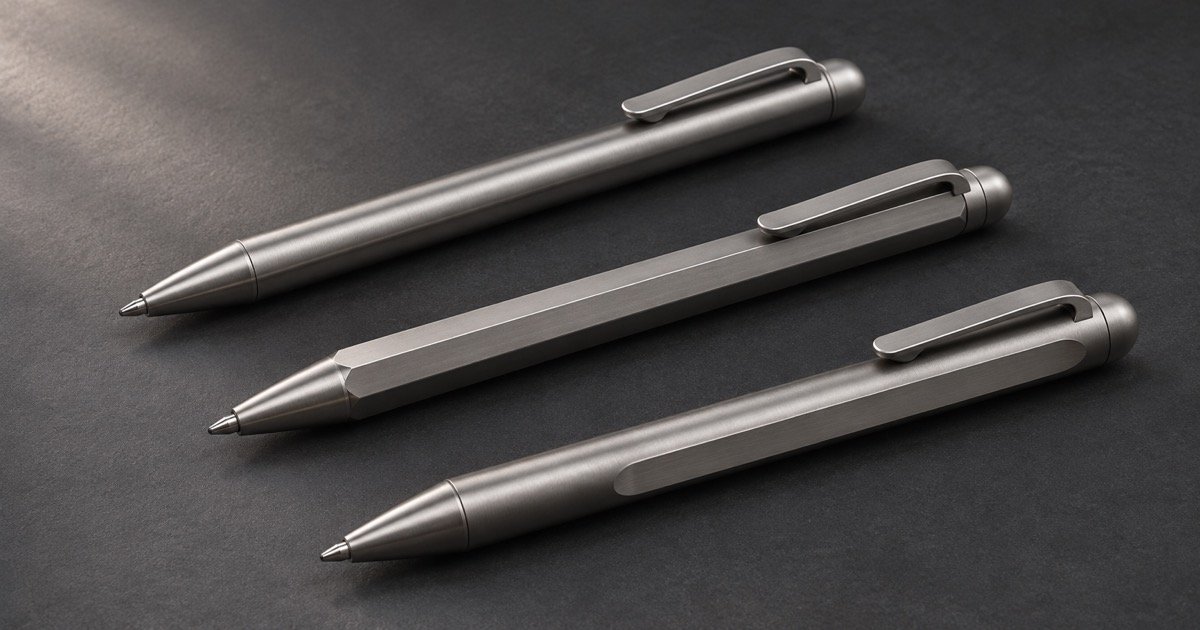
A titanium tactical pen that rolls off a desk creates a small but recurring usability problem. A pocket clip, a flat on the barrel, or a polygonal cross section may reduce that movement. Each approach also changes how the pen rests in the hand, fits an organizer, and looks after finishing.
For EDC brands, anti-roll behavior belongs in the product brief alongside writing comfort and carry. This guide compares practical barrel options and explains what to evaluate before approving a design.
What Makes a Pen Resist Rolling?
A pen rolls when its contact geometry and mass distribution allow it to rotate across a surface. A cylindrical barrel presents a continuous curved contact. A flat or projecting feature interrupts that motion, but the result depends on where the pen touches the desk, its orientation, the surface, and the complete assembly.
A clip can serve as a stop only when it reaches the contact surface in the tested configuration. A retractable pen, a capped pen with the cap removed, and a pen with its cap posted may rest differently. Evaluate every configuration that users will encounter.
Barrel Options Compared
| Option | Useful characteristics | Questions to resolve |
|---|---|---|
| Round barrel | Continuous grip surface and familiar silhouette | Does the clip stop movement in every normal resting position? |
| Faceted barrel | Multiple resting faces and clear orientation | Are corners comfortable during extended writing? |
| Round barrel with a flat | Localized resting surface with mostly curved grip | Does the flat reach the actual contact zone? |
| Raised anti-roll feature | Can preserve a round grip | Does the projection snag fabric or press into the hand? |
Separate the Grip Zone From the Resting Zone
A full-length hexagonal body is one solution, but a flat can also sit behind the grip. This lets the fingers contact a rounded area while the rear body provides a resting face. The transition needs deliberate dimensions and edge treatment so it feels intentional.
Compare hand positions before committing to the section. Some users rotate the pen slightly while writing; others use a consistent orientation. A corner that feels acceptable during a brief inspection may become a pressure point during a longer task. See the titanium tactical pen grip texture comparison for the separate effects of grooves and knurling.
Review Clip Orientation and Clearance
The clip should be considered with the barrel rather than attached after the shape is frozen. Its mounting position determines which face sits upward, whether the pen rocks between contact points, and whether the clip interferes with the grip.
On a removable clip, check the permitted configuration after removal. If the pen depends on that clip to resist rolling, describe the behavior accurately. Use the pocket clip design guide to review ramp, clearance, attachment, and pocket contact.
Include the Mechanism and Refill
A rear button, bolt, cap, and refill change mass distribution and resting height. An empty barrel is not a representative test article. Check the installed refill, spring, spacer, clip, and any rear component together.
The pen weight and balance guide helps document assembly configuration. For mechanism-specific behavior, compare bolt-action, click, and capped titanium pens. Avoid solving desk stability by adding a projection that makes actuation less comfortable.
Check Manufacturing and Finish Transitions
Facets require controlled width, alignment, and transitions. A localized flat needs defined endpoints. Cosmetic highlights can expose variation even where the nominal dimensions are acceptable. Ask the manufacturer how the geometry will be machined, held, deburred, and inspected.
Specify edge treatment around the flats and corners using edge-break and chamfer guidance. Then approve the geometry with the intended finish. Brushing direction, polishing, blasting, and anodized appearance can change the visual emphasis of each face.
A Practical Evaluation Sequence
- Identify every normal resting configuration, including cap positions and removable hardware.
- Use the complete assembled pen with the approved refill.
- Place it in several orientations on representative work surfaces.
- Record rocking, rotation, travel, contact marks, and interference.
- If an inclined-surface comparison is needed, define the angle and method consistently.
- Write for representative tasks and inspect finger pressure points.
- Test pocket insertion, retrieval, snagging, and organizer fit.
- Repeat the checks after design or finish changes.
Do not turn a casual desk trial into a quantified performance claim. Any published limit needs a defined method and supporting results. The broader titanium pen sample testing checklist provides the production approval context.
Choosing a Platform
Choose a round body when a continuous grip is important and the clip provides acceptable resting behavior. Choose facets when orientation and stable resting faces support the intended user. Choose a localized flat when the team wants to preserve a curved grip while changing desk contact.
The faceted titanium tactical pen platform and titanium tactical pens category provide starting references. Confirm the exact configuration rather than assuming all products share the same behavior.
FAQ
Is a hexagonal pen always more comfortable?
No. Corner treatment, diameter, grip position, hand size, and writing duration determine comfort.
Can a clip replace an anti-roll flat?
Sometimes. Test its contact with the surface in all intended configurations.
Should the whole barrel be faceted?
Not necessarily. A separate resting zone may meet the goal while preserving a round grip.
Develop a Pen Around Its Daily Use
Explore the EDC Gear hub and titanium tactical pen selection guide. Brands can review Alloywright capabilities and submit a barrel concept or reference pen for review.