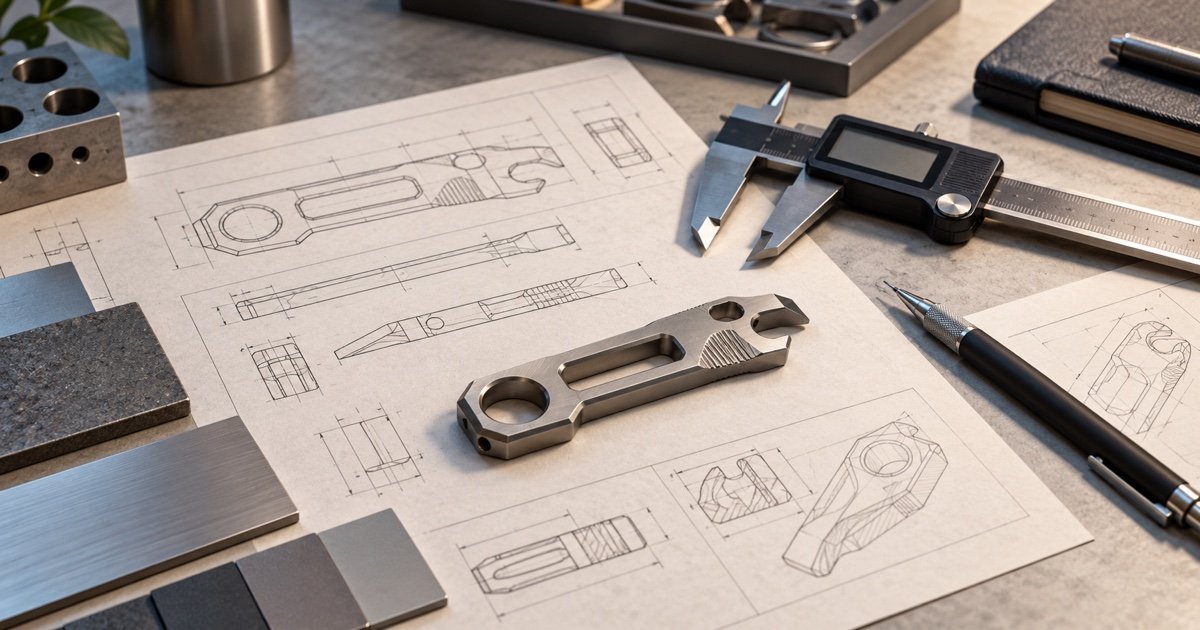
A useful request for quotation does more than ask for a unit price. It gives a manufacturer enough controlled information to understand the product, identify assumptions, separate confirmed requirements from open decisions, and quote comparable scope.
For a custom titanium EDC product, the RFQ should connect design files, material, finish, branding, packaging, sample stages, inspection, quantity scenarios, and commercial terms. Missing information does not always prevent a quote, but it can make supplier responses difficult to compare and push important decisions into later revisions.
Start by Identifying the Project Type
State whether the project is a private-label version of an existing product, a modification of a reference platform, or an original design. Include the intended use, target customer, sales market, and current development stage. A sketch, reference sample, 3D model, and production-ready drawing do not represent the same level of definition.
If the project is still deciding between a known platform and original development, review existing-product customization versus original development. The quotation should distinguish confirmed work from engineering activities that still need to be scoped.
Custom Titanium EDC RFQ Checklist
| RFQ section | Information to provide | Why it matters |
|---|---|---|
| Project identity | Product name or code, revision, RFQ date, contact, and confidentiality requirements | Prevents files and quotes from being mixed across versions |
| Design definition | 2D drawing, 3D model, reference sample, sketches, critical dimensions, interfaces, and intended use | Shows what is fixed and what still needs development |
| Material | Requested alloy or grade, condition if relevant, certification expectations, and acceptable alternatives | Avoids comparing quotes based on different material assumptions |
| Finish and appearance | Finish process, color, texture, cosmetic zones, range references, logo method, and artwork | Defines visible requirements and process scope |
| Function and testing | Mechanisms, moving parts, fit, compatibility, test methods, acceptance criteria, and prohibited use | Connects the product claim with verifiable requirements |
| Samples | Prototype purpose, sample stage, quantity, production-intent requirements, and approval record | Clarifies what each sample must prove |
| Packaging | Unit packaging, inserts, labels, barcodes, carton requirements, artwork status, and pack-out | Prevents packaging work from appearing late in the quote |
| Quantities | Sample quantity plus realistic production quantity scenarios | Lets suppliers show tooling or setup effects without inventing a fixed commitment |
| Quality and delivery | Inspection responsibilities, reporting, shipment destination, target timing, and required documents | Defines the operational scope around the parts |
| Quote format | Requested cost breakdown, assumptions, exclusions, validity, payment terms, and lead-time basis | Makes supplier responses easier to compare |
Control the Drawing and File Revision
Give every RFQ package a revision identifier and list the included files. A supplier should not have to guess whether an emailed drawing, a later CAD model, or a marked-up screenshot controls the quote. When dimensions conflict, define which document takes precedence or ask the supplier to flag the discrepancy.
The guide to preparing a custom titanium product specification explains how intended use, dimensions, materials, appearance, and acceptance requirements work together. Do not place critical requirements only in an email thread if they belong in the controlled specification.
State Material Requirements Without Over-Specifying
If a titanium grade is required, name it and state what supporting documentation is expected. If the grade is not yet decided, describe the functional and appearance requirements and request alternatives with assumptions clearly identified. Avoid using “titanium” as a complete material specification.
For relevant EDC choices, compare Grade 2 and Grade 5 titanium and the process for reviewing a titanium material certificate. Any certification, traceability, or testing requirement should be confirmed for the specific project rather than assumed.
Mark Critical Dimensions and Tolerances
A drawing filled with tight tolerances can raise inspection and manufacturing effort without improving the product. Identify the dimensions that control assembly, refill fit, thread engagement, pivot alignment, clip position, sealing, or another functional interface. Allow the supplier to ask where a broader tolerance is acceptable.
Use the framework for choosing tolerances for titanium EDC products and request a manufacturability review before treating every dimension as frozen. If the RFQ includes multiple assembled parts, note the interfaces and any required mating samples.
Define Finish, Color, Logo, and Cosmetic Standards
Name the intended finish and provide a physical or controlled visual reference when appearance is important. Identify high-visibility faces, contact zones, hidden surfaces, permitted fixture marks, edge expectations, and any areas that must remain unfinished. For anodized products, do not treat a screen color as a complete acceptance standard.
Link finish decisions to the titanium surface finish guide and document logo size, position, orientation, contrast, and artwork format using the guidance on private-label logo placement. Ask the supplier to state the proposed marking method rather than assuming every method produces the same result.
Separate Engineering, Approval, and Production Samples
State what each sample is expected to prove. An engineering sample may test geometry or mechanism behavior while using a temporary finish. A pre-production sample should represent the intended production configuration closely enough to support release. A golden sample can help control appearance and feel, but it does not replace drawings and measurable criteria.
Define the sample quantity, configuration, delivery contents, reporting, and approval process. The article on engineering versus pre-production samples helps prevent one sample from being asked to answer every project question.
Include Packaging Before the Final Quote
Packaging can involve inserts, protective films, labels, barcodes, instructions, retail boxes, master cartons, and artwork review. Even if artwork is not complete, state the intended packaging level, approximate product presentation, and what the supplier should include in the quotation.
Use the private-label titanium EDC packaging guide to document packaging as a controlled part of the product rather than a late accessory.
Ask Suppliers to Expose Assumptions
Request separate lines for development, samples, tooling or fixtures if applicable, unit production, finish, marking, packaging, testing, and freight basis. Also request assumptions, exclusions, quotation validity, payment terms, estimated timing basis, and the conditions that could change the price.
When responses arrive, use the method in comparing quotes from custom EDC manufacturers. The lowest unit number may represent a different material, finish, packaging scope, inspection plan, or quantity basis.
Common RFQ Mistakes
- Sending files without a revision list.
- Asking for “Grade 5 titanium or equivalent” without defining what equivalent means.
- Requesting a color from a screen image alone.
- Applying tight tolerances to every dimension.
- Omitting the intended product use and critical interfaces.
- Mixing engineering samples with production-approval samples.
- Leaving logo, packaging, inspection, and shipment scope until after price comparison.
- Comparing quotes without normalizing assumptions and exclusions.
A Practical RFQ Submission Sequence
- Assign a project code and package revision.
- List every drawing, model, artwork file, and reference item.
- Summarize intended use, target market, and development stage.
- Separate fixed requirements from open questions.
- Provide sample and production quantity scenarios.
- Request the same quote structure from each supplier.
- Collect technical questions before comparing commercial totals.
- Record all agreed clarifications in the next controlled revision.
If minimum order quantity is still under discussion, review what determines MOQ for custom EDC products instead of forcing a quantity unsupported by the project.
FAQ
Can I request a quote with only a reference sample?
Yes, a manufacturer may be able to provide an initial assessment, but the quote should identify assumptions and any design, measurement, testing, or documentation work needed before production.
Should I send both 2D drawings and 3D files?
For custom parts, both are useful when available. The 3D model defines geometry, while the drawing can identify tolerances, materials, finishes, notes, and inspection requirements that may not be clear in the model.
Should an RFQ include multiple quantities?
Realistic quantity scenarios can show how setup, tooling, material utilization, packaging, and production planning affect the quotation. They should reflect plausible purchasing plans rather than arbitrary volume.
Does an RFQ need final packaging artwork?
Not always. However, it should state the packaging concept, components, artwork status, and expected supplier scope so the quotation does not omit material work.
Ready to Submit a Titanium EDC RFQ?
Browse the OEM & Private Label hub and Alloywright product platforms for useful references. You can review Alloywright’s development and manufacturing capabilities or submit your drawing, sample, or requirement sheet for a project-specific review.