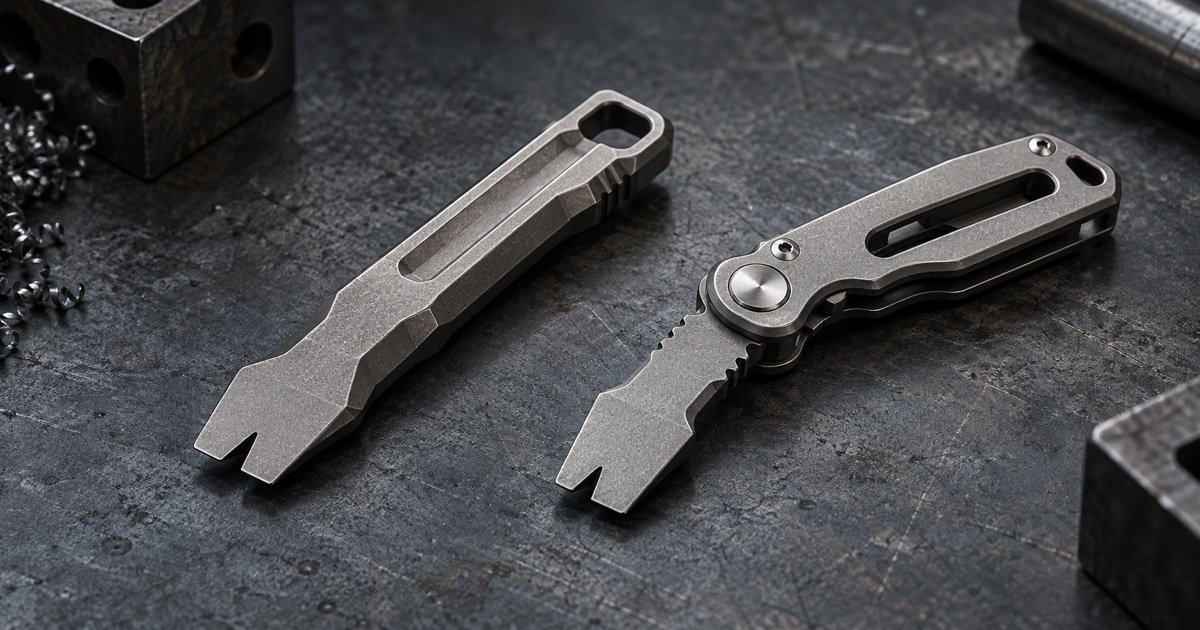
A fixed pry bar and a folding pry bar can provide similar working features while creating very different carry, assembly, testing, and manufacturing requirements. The fixed design favors a direct one-piece structure. The folding design protects or shortens the working end for carry, but adds a pivot, stop, lock, and more interfaces that must perform together.
For an EDC brand, the better architecture is not simply the one with more parts or a more compact silhouette. It is the one that matches the intended task, carry method, maintenance expectations, target user, and validation plan.
What Is the Structural Difference?
A fixed pry bar transfers user input through a continuous body. Features such as the pry edge, scraper, driver, bottle opener, grip, and attachment point are machined or formed into the same piece or into a largely rigid assembly. This can make the load path easier to understand, although thickness transitions, cutouts, corners, and surface condition still need engineering review.
A folding pry bar divides the product into a working member and a handle or frame. A pivot guides movement, a stop defines the open position, and a lock or detent controls retention. The joint does not automatically make the product weak, but it introduces interfaces, clearances, wear surfaces, fasteners, and possible misuse conditions that a fixed bar does not have.
Fixed vs Folding Titanium Pry Bar Comparison
| Decision factor | Fixed design | Folding design |
|---|---|---|
| Carry size | Full working length is always exposed | Working end can fold into the handle or frame |
| Part count | Usually fewer components and interfaces | Requires pivot hardware plus a retention or locking strategy |
| Load path | More direct through the body | Passes through the working member, pivot, stop, frame, and lock as applicable |
| Pocket protection | Tip geometry remains exposed unless covered | Handle can shield the working end when closed |
| Maintenance | Generally easier to inspect and clean | Debris, fastener condition, lubrication policy, and joint wear need attention |
| User interaction | Immediately ready with no opening step | Opening, closing, lock confirmation, and pinch points affect use |
| Manufacturing control | Focuses on body geometry, edges, thickness, and finish | Adds alignment, pivot fit, stop position, lock engagement, and assembly control |
| Customization | Large uninterrupted surfaces may simplify marking | Multiple visible components can support finish contrast but require appearance coordination |
Choose the Carry Method Before the Mechanism
A compact folding format can reduce exposed length, but it may become thicker than a flat fixed bar. A fixed bar can disappear along a pocket seam or ride on a keychain, while a folding version may suit a pouch or dedicated clip. Measure the complete carry envelope rather than comparing length alone.
Review pocket versus keychain carry for compact EDC tools and decide how quickly the tool must be accessed, whether it may contact a phone or other gear, and whether the working edge needs a cover. If a clip is planned, its position, thickness, and retrieval behavior belong in the same review.
Define the Intended Work, Not Just the Tool Name
“Pry bar” can describe products intended for light opening, scraping, package work, lifting small covers, turning a driver bit, or other compact-tool tasks. Those activities do not create the same loads or user behavior. Write down the intended and prohibited uses before selecting thickness, length, edge geometry, or a folding mechanism.
The article on how to choose an EDC pry bar offers a broader framework for size, grip, features, and carry. Product claims should follow verified tests for the final configuration; the material name alone does not establish a safe working load.
Review the Pivot, Stop, and Lock as a System
On a folding design, the pivot should control motion without creating unacceptable play or binding. The stop should define the working position without concentrating damage in an unintended contact area. A lock, if used, needs clear engagement and release behavior. Fastener retention must be compatible with service, assembly, finish, and the approved production process.
Check open and closed positions, lateral and vertical movement, partial engagement, contamination, edge contact, and behavior after repeated operation. If parts are replaceable, specify who may service them and how the approved configuration is restored. The guidance on replaceable parts in titanium EDC products helps define that boundary.
Compare Ergonomics in Real Tasks
A fixed bar can be thin and simple, but thin edges or aggressive cutouts may create pressure points. A folding handle may offer more grip area, yet pivots, fasteners, lock releases, and frame gaps can affect comfort. Evaluate the tool with dry hands, wet hands, and gloves when those conditions match the intended use.
Observe how users orient the tool, where they place their thumb, and whether their hand approaches a pinch area during closing. A feature that looks clear in a CAD view may be less obvious during one-handed use.
Plan Finish and Cosmetic Zones Around Movement
Stonewashing or blasting can create a practical appearance for EDC tools, while brushed or polished surfaces can emphasize machining and shape. On a folding product, moving components can contact each other and produce witness marks. Those contact zones should be understood before approving cosmetic standards.
Use the titanium surface finish guide to compare appearance and handling considerations. If different components receive different finishes or colors, document boundaries, orientation, and acceptable variation rather than relying on one marketing image.
Build a Test Plan for the Architecture
- Confirm material callouts, dimensions, critical interfaces, and revision identity.
- Inspect pry edges, corners, cutouts, attachment points, and finish transitions.
- For folding versions, measure pivot fit, stop contact, lock engagement, and fastener condition.
- Perform representative tasks using a written method and defined acceptance criteria.
- Check carry comfort, accidental opening risk, snagging, access, and adjacent-item contact.
- Repeat opening and closing according to the project test plan, then inspect wear and play.
- Retest after any geometry, hardware, heat-treatment, finish, or assembly-process change that can affect function.
Connect these checks with the titanium EDC prototype testing checklist and apply tolerances according to function rather than visual preference alone.
Common Development Mistakes
- Choosing folding solely because the closed length looks smaller.
- Comparing overall length without comparing thickness and carry envelope.
- Adding a lock without defining partial engagement or release behavior.
- Using large decorative cutouts without reviewing the remaining load path.
- Approving a smooth prototype without testing contamination and repeated use.
- Applying finish before checking contact and wear zones.
- Making performance claims without an approved method and final-configuration evidence.
Which Design Should an EDC Brand Choose?
Choose a fixed format when immediate access, low part count, easy inspection, and a thin profile are central to the product. Choose a folding format when protecting the working end or reducing closed length justifies the added mechanism, thickness, assembly, and validation work. A hybrid concept is only useful if it solves a defined user problem.
Compare the available titanium pry bar platforms as references, then use functional tolerance planning and DFM review before freezing a custom architecture.
FAQ
Is a fixed titanium pry bar always stronger than a folding one?
No universal conclusion can be made from architecture or material alone. Geometry, section thickness, pivot and stop design, manufacturing condition, load direction, and test method all affect performance.
Does a folding pry bar need a lock?
That depends on the intended tasks and risk assessment. A detent, friction joint, slip joint, or positive lock creates different behavior and must be evaluated in the complete product.
Can titanium pivot against titanium?
Material pairing, surface condition, clearance, lubrication policy, contamination, and cycling require engineering review. Titanium contact can be sensitive to galling in some conditions, so the joint should not be specified by material name alone.
Developing a Titanium Pry Bar?
Explore the EDC Gear hub for related carry decisions. Brands can review Alloywright’s product development capabilities or share a sketch, reference sample, or requirement sheet for a project review.